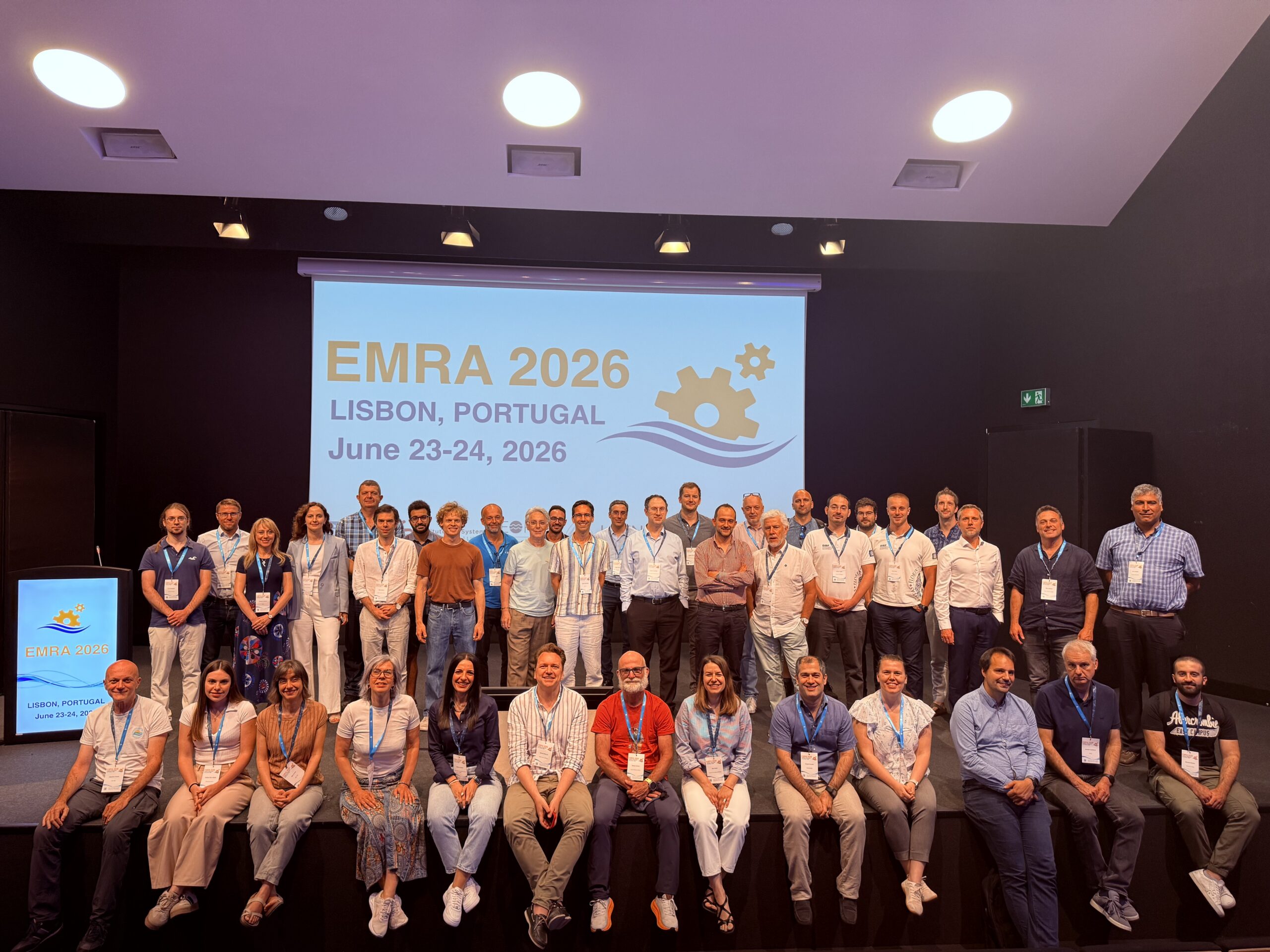
A committee from the ISR-Lisboa recently organised the 12th edition of the EU-funded Marine Robotics and Applications Workshop (EMRA ’26), held on 23 and 24 June 2026, at Pavilhão do Conhecimento – Ciência Viva, in Lisbon. The edition marked Técnico’s return to the role of host eleven years after first welcoming the workshop to Portugal in 2015.
Coordinated locally by David Cabecinhas and António Pascoal, the workshop gathered around 80 participants for a single-track programme, combining EU project presentations, industry contributions and keynote talks, in line with the format established by the EMRA series since its first edition in Rome in 2014.
Opening the workshop alongside the Técnico hosts, Massimo Caccia (CNR-INM), one of EMRA’s founders, looked back on how far the field has come since the first Rome edition twelve years ago. Recalling his own ties to Lisbon, “here in 1999, the best time of my career life”. He noted that, over the years, “marine robotics has changed from being viewed as just branch of marine biology to being recognized as a whole field on its own, and one of great innovation,” a shift visible in the maturity of the projects on stage this year.
The first day started with a keynote from Miguel Miranda, from AIR Centre (Atlantic International Research Centre), on Maintaining and Improving Ocean Observation. His message landed strongly: the ocean economy will only become sustainable if it is built on shared, open observation infrastructure. Stressing that an “increasingly globalised world” still demands “local answers”, his closing challenge set the tone for the rest of the programme: “We need standardised information and measuring tools that anyone can use. If you can do that, you will change the world.”
The programme covered four main areas:
- Widening and Excellence projects (UWIN-LABUST, SeaTecHub, MARBLE, MaRITeC-X, LORELEI-X, Twilighted); international and Innovation Action projects, including the GLADIUS (in which Técnico is a partner) and Tow-fish activities on towed underwater vehicles;
- Industry session with seven mostly local companies, among them BlueOasis, Hertel Robotics, HidroMod, SEA.AI, OceanScan, In2Sea and Norway’s Kongsberg Discovery;
Regional EU-funded projects such as MIMISK, AMIS, BRIGANTINE, CLEAR, SMART-WATER
Day 2 featured keynote contributions from Sérgio Jesus (University of Algarve), on the transition from active to passive underwater acoustics, and João Vitorino (Hydrographic Institute), on monitoring the Portuguese coastal ocean. The workshop closed with a session led by Elena Paifelman and Massimo Caccia (CNR), introducing the European Ocean Research and Education Alliance (EOREA) and launching the working group for its Collaborative Research and Education Programme (CREP) in marine robotics.
Throughout these days the goal was clear: figuring out the most compelling and complex challenges ahead, and what tools the community is building to answer them. Off-programme, the EMRA 2026 dinner at D’ Bacalhau gave participants the unhurried Lisbon evening that, by all accounts, is becoming part of the workshop’s signature.
Further information and proceedings available at: https://emra-26.marinerobotics.eu.